Our Mission: Catalyst & Hub
Baltimore Modular, Inc. (BMOD) is a Maryland nonprofit. Our mission is to advance scalable systems-based approaches to addressing housing affordability and economic opportunity in Baltimore and the surrounding region, and to accelerate industrialized construction broadly.
Catalyst & Hub
Baltimore Modular (BMOD) strives to be a catalyst and hub for Industrialized Housing Delivery (IHD) efforts across the Baltimore region, adapted for scalable scattered-lot infill construction, vacancy reuse and rehabilitation, and existing homeowner stabilization. Our work takes Baltimore’s street grids, lot sizes, rowhouse typologies, and neighborhoods as the base into which we connect offsite-made assemblies (2D panelized and 3D volumetric systems).
Baltimore is our motherboard
Rather than displace/replace, we develop standardized interfaces linking existing conditions and stakeholders with IHD products to deliver 21st-century system upgrades. In a recent BMOD workshop, MOD X concluded that “Maryland’s highest-rated offsite value proposition is neighborhood revitalization through retrofit / adaptive reuse.” We cannot demolish everything that has come before; the most sustainable house/city is the one that already exists.
Why now
Industrialized Housing Delivery (IHD) has great potential to address affordable housing shortages, yet most IHD efforts, geared toward tabula rasa ground-up construction, provide few solutions for legacy cities. Baltimore has 11,481 vacant buildings, 21,620 vacant lots and 1,677 older residents waiting for City home-repair help. While the City’s plan calls for $3 billion in public funding, part of an $8 billion effort to rebuild and retrofit vacant lots and houses, Baltimore’s traditional housing delivery ecosystem cannot meet this challenge. A recent Baltimore Banner article reported that for every three vacant homes the City eliminates, two new ones appear. The clock is ticking: without an IHD approach for scattered urban lots and mass retrofits, people will leave their communities and large swaths of our existing urban fabric will be demolished.
Years of research and advocacy have validated a scalable holistic systems-based approach to addressing our region’s most pressing issues: limited affordable housing, vacant lots and rowhouses, homeowner stabilization, construction labor shortages, and a lack of employment opportunities for large swaths of our population. Now it’s time to build.
Why it matters
One jobsite, one commute. A factory with access to public transit makes for a predictable commute.
Care for care providers. Work hours can line up with typical childcare hours, and a factory could offer childcare on site.
Economies of scale. Making and assembling standard parts from a product platform can save both time and money.
Quality control. Controlled factory conditions support consistent quality and precision.
Worker safety and comfort. Indoor work stations can be safer and more comfortable than an open site.
Sustainability. Factory production can cut material waste and the travel of materials, machines and workers.
Six activities, one hub
The BMOD Hub is to be both a physical space and a virtual network for six distinct, but often overlapping, activities: Impact, Design, Make, Develop, Work and Augment. See the six activities.
The path ahead
Each stage depends on funding and on proving the one before it.
Planning (Year 0). EPA grant complete: concept platform, pilot design, hub and workforce research.* Read about the EPA planning work.
Pilot (Year 1). 20+ properties, a retrofit + infill mix, with a community development organization, financing and team.
Microfactory (Year 2). Local vertically integrated production; jobs and supply chain.
Scale & Replicate (Year 3). A three-year ecosystem: demonstrate, integrate, systematize.
* For the project titled “Baltimore Modular (BMOD)”, Christina D. Long, Ethan Cohen, Brent Sturlaugson, and Kamalesh Panthi served as subcontractors to the Maryland Center for Construction Education and Innovation (MCCEI) under the EPA Thriving Communities Grant administered through Green & Healthy Homes Initiative (GHHI). In this capacity, BMOD team members provided leadership on research, design, technology, and community and stakeholder engagement in support of the BMOD project, which focuses on offsite construction strategies for housing revitalization and workforce development in Baltimore.
The big idea
As Detroit 1960 was to the auto industry, Baltimore 2030 can be to industrialized construction: rebuilding its housing stock and providing economic opportunity for residents. Baltimore will show the nation how the industrialized housing delivery revolution starts with existing homes and lots in dense urban communities.
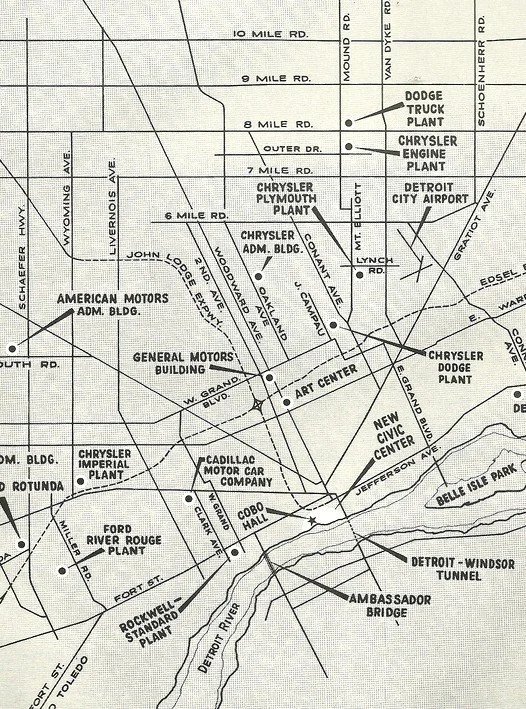
Detroit’s auto industry, 1960.
What we prove here can help other legacy cities do the same. Like Baltimore, these older industrial cities have aging homes, vacant lots and neighborhoods worth keeping.
How BMOD is organized
BMOD is independent and governed by its Board of Directors. Meet the Board & Team.
BMOD does not provide architecture or engineering services itself. Any such work is delivered by licensed partner firms.
The process is the product
Let’s cultivate a local, collaborative, evolving, learning ecosystem in which the processes of production, as well as the products we make, serve to address our region’s challenges. Let’s activate a region of makers. The process is the product.
Baltimore Rebuilds Baltimore.